Category Archives: Catching Raindrops

What is Catching Raindrops in Water Buckets?

As we approach the sixth year anniversary of the start of Catching Raindrops in Water Buckets, I want to revisit its beginning. It’s interesting how things seem to work in a cycle. Once again, we’re watching the stock market, as it plunges one day and then regains points one or two days later. While the unemployment numbers look good, people are still underemployed, working jobs for less money today than they were 10 years ago. The rising cost of housing and the new mortgage laws have kept some people from attaining that American Dream, while struggling to find reasonable cost of rent in many markets.  And while the interest rates are rising, and the cost of living is higher, most people haven’t seen a significant increase in their paycheck since before the economic crash a decade ago.

I started Catching Raindrops in Water Buckets first as a writing assignment for myself. I used journaling as a way to process the massive changes that were happening in my life, particularly the time period following my change in jobs. Change, itself, was new to me. I had many other jobs before, having started working part-time as a young teenager, and full-time right out of college. But all of my positions were “upwardly mobile.” They weren’t all financially mobile, but each one prepared and positioned me for something that built upon the next level – until reaching that level where the financial rewards started paying off.

I was brought up to always live within whatever means I was in at any particular time in my life. Whether I was saving money for high school band trips; or to pay my own college tuition; or buying my first car after only a year at my first job, I learned how to practice discipline, patience, and planning in order to take care of the things I needed to take care of. And while I wasn’t perfect at it, I worked hard to be smart with my finances. I opted to live at home during college. I had three roommates when I finally got into my first rental house after Graduate school. And my first car was safe, boring, and inexpensive!

But in December, 2008, things changed. And those changes didn’t line up with my plans. They were a shift away from my otherwise, upwardly mobile status in life. And it was playing out in a non-temporary way.

There I was, along with hundreds of thousands of other people around the country, trying to deal with the impact of a Recession that few people saw coming, and most people had no idea how much it would personally impact them. I woke up one morning, and realized that the “normal” life I’d built for myself had been uprooted. So the only sanity I could hold on to was through writing. It was my means of processing the entire episode. Through that, I realized I was going to have to change some things; not just for this moment, but forever.

book with coffee cupAs I was going through my own world of “adjustments,” I watched others trying to make it through theirs. Not every life adjustment had to do with a job loss – but all of them impacted financial stability in some way. Friends going through divorces; neighbors impacted by a spouse’s inability to work; loss of income after the loss of a spouse; people dealing with unexpected medical diagnosis amidst inadequate medical insurance; unexpected legal issues that were emptying bank accounts; and a host of other issues, including people working fewer hours, or dealing with a cut in pay to prevent layoffs.

There were people around me who were trying to just “deal” with the things happening to them. Not all of them seem to understand that part of dealing would need to include an adjusted mindset. It was what I learned through journaling. I realized I couldn’t continue to focus on what was “normal” in my life prior to the major changes that had just happened. That normal didn’t exist anymore. I couldn’t keep doing the same things; at least not in the same way. I had to adjust to the new situation I found myself in. And I wanted to help other people; namely women, to do the same.

That’s why I took Catching Raindrops in Water Buckets off the pages of my personal journal and onto the Internet with this blog site and Facebook group page to share information and to encourage peer-to-peer participation. Women helping women work through issues and situations that they may not be ready for, or could use an extra perspective in dealing with.

Catching Raindrops in Water Buckets focuses on teaching, sharing, and learning how to use what you have today to help plan for what may not be there tomorrow. I hope there are some of you willing to share your story too!

Adjusting Your Life to Your New Normal.
Do You Care about the Stock Market?

The stock market crash of 2008 occurred on September 29, 2008. The Dow Jones Industrial Average fell 777.68 points in intra-day trading. Until 2018, it was the largest point drop in history.

For the average American, like myself, the reason for the crash wasn’t nearly as important as the “what to do?” and “how will this effect me,” that came after.

Ten years ago, at the start of 2008, when the housing market, and everything else felt like they were trying to keep their balance on a large patch of quicksand, the one thing almost every Financial Counselor and radio and television station’s “Talking Head,” continued to say to anyone with investments, was “don’t panic,” “stay in the the game.” Numerous so-called experts advised people to keep their money in their 401Ks. “If you take it out, you won’t be able to earn it all back,” I remember someone saying.

The Fall of 2008 came, and thousands of people like myself saw the huge financial impact of the “crash of 2008,” on our 401Ks. And by the end of the year, thousands of people, like myself, were no longer employed at the same companies who were contributing to their 401K. What did that mean? It meant there was no “earning it all back.” My $40,000 loss was a permanent one.

As small businesses fought to keep their employees, and many big business continued to let go of theirs; people scrambled to find other jobs in the middle of what turned into not just a stock market crash, but a job crisis for America.

Suddenly, two-income households were down to one; one income earners struggled to keep the lights on and mortgages paid, even as they watched the value of their homes decline, and foreclosures and short-sales were on the rise. People walked away from the homes they had invested five, 10 even 15 years into, taking the hit on their credit report rather than continue to pay on mortgages that were underwater.

Finger pointing oftentimes claimed people were living above their means, as if everyone had purchased homes twice the price their monthly income could afford. But hardly anyone talked about those living well within the means they had created prior to the mudslide of a housing, jobs, and stock market rollercoaster ride!

Now, 10 years later, as some applaud the recent decline in the unemployment rate, few have continued the conversation about those who are still underemployed; those who never recovered financially from where they were prior to 2008, 2009, 2010 — to where they are now.

According to a survey by PayScale, “as many as 22 million U.S. workers can be considered “underemployed” — that is, they have a job that doesn’t put their education, experience or training to work, or they are working part-time when they’d rather have a full-time job.”

As I watched the stock market take a familiar ride this week (February 5-9), I shuttered at the thought of returning to life 10 years ago, even as I heard those same familiar warnings: “don’t panic,” “leave your money in your 401K,”  “you’ll earn it back.”

There was a new twist this time. Everyone keeps saying that the market is “correcting itself.” Thursday’s CNN Money‘s headline exclaims: Dow plunges 1,033 points and sinks into correction.  The article went on to say:

Fears about the bond market, inflation and interest rates seized investors again Thursday and drove the Dow, the S&P 500 and the Nasdaq all into the red for the year.

The Dow finished with a decline of 1,033 points, the second-worst point drop in history, eclipsed only by Monday’s 1,175-point nosedive.

I’m no financial expert; not even close! I have never individually played the market, or even bought stocks or bonds for myself; trusting financial people who went to school to understand all of the ups and downs of investing and the markets.

What I can speak to is being a survivor of the Recession of 2008-2009, having not only gone through it, but walking right alongside so many friends and peers who walked through it as well. There was a long-lasting effect on us, not just on our finances, but on life as a whole.

Caution.

That’s my word of the day, the month, the year! Proceed with caution.

Get your financial house in order. Stop spending on things you don’t need, and practice more discipline to save and plan for those things you want. If you’re living off of three credit cards, reduce it down to just one. If you’re thinking about buying another car, when there’s nothing wrong with the one you have, don’t. Instead, put the money you would be spending on your monthly payment, away. Make sure your savings account has enough money in it to cover all of your bills for two or three months should something unfortunate happen and you lose your job, have unexpected medical expenses that your insurance won’t cover, or need to help a family member out of an emergency.

Trust is hard to rebuild. So when things seem to be building up to look the same as they did before, it’s kinda hard to believe that they’ll turn out much different. The experts say so. But my survival instincts tell me to be prepared for the “just in case” either way.

The way I see it, if they could see 2008 coming, they would have put measures in place in 2006 and 2007 to avoid it. The future isn’t ours to see; but it can be ours to prepare for.

The Benefits of Aging

I can’t remember which birthday it was. But I do remember that I was still pretty “young.” Not elementary or high school young; but you know, young; probably in my 20s. I must have been dreading another birthday, and vocalizing it within ear shot of my mother. She reminded me of how young I really was, and that the time would come when I truly would be considered “old.” But for that day, that time period in my life, I was no where near that place.

Then she said something profound; something I’ve heard myself repeat to more than just a few friends over the years. To paraphrase, “If you’re not getting older, you’re dead.

Leave it to my mom to be so blunt. But she was right. Aging was one of those things we could use to measure living by. We’re still here, turning another year older. Yah!

I remember when a friend of mine turned 50. In the age of social media, everyone shares everything. So she posted a photo of her AARP packet, and a disapproving look on her face, captioned: REALLY?

I understand exactly where she’s coming from. I mean, the very nature of the AARP organization was designed for retired people (American Association of Retired Persons). Who retires at 50; except maybe a career military person who joined right out of high school or college. Or perhaps someone lucky enough to have built a company that a larger corporation came bought up!

And let’s face it. When we were in our 20s and 30s, people who were in their 50s were the “older people” — teachers, relatives, and friends of our parents.  Now, we’re “those people.”

Sometimes, I do sit back and wonder where all the time has gone. I mean, how did I become a card caring AARP member? One moment, you can’t wait to get out of high school. The next moment you’re counting the years out of college in terms of decades! But there are certainly some benefits to getting older, besides just being wiser.

And AARP has plenty of those! If you’re a member, you probably already know. But if you’re not, check out all of the advantages there are to turning 50!

https://www.aarp.org/benefits-discounts/?intcmp=DSO-HDR-BENEFITS-EWHERE

I knew about some of the discounts they offered, from discounted movie tickets, to savings on hotel reservations and rental cars. But I was surprised to learn just how many restaurants and retail outlets also participated in the program. I eat at Outback a few times a year, and had been eating at Bonefish Grill on a bi-monthly basis over last year, and had no idea I could have been saving ten percent on my bill each time! And while I knew I could be getting discount tickets for Regal Crown theaters, I just found out that you can also get three dollars off a popcorn/soda combo!

And for someone like me, who works in the live entertainment industry, you think I would have known that the AARP membership benefits also include discounts on some live events, including 15-20 percent off tickets for Cirque du Soleil shows!

Well, I guess it’s my fault for not checking it out before now. But now that you know, you won’t have an excuse. Getting rewarded for getting older? Not so bad after all!


How Wearing Sweaters in the Winter Can Help Cut Your Electric Bill

I laughed (again) as I read through the growing outrage on Facebook over some recent electric bills. Every year, around the same January through February time period, the same neighborhood FB page gets loaded with comments from people complaining that their bill had doubled, and even tripled over one month. It was a neighborhood with mostly older homes; with many if the homeowners probably not taking the steps to modernize their doors, windows, and insulation. Whether or not the people posting the comments were exaggerating or not, there was no doubt in my mind that their heating bill had likely jumped up, with us coming off of a couple weeks of low temperatures in our area. But how high a bill goes depends, in part, on what people are willing to do to help keep it down.

A month earlier, a friend poised the question on her FB page, asking what people set their thermostats on during the winter. I was very surprised to see a number of responders saying everything from mid-70 to even as high as 78 degrees! I could just feel the sweat pouring down my back thinking about how hot my house would feel at that setting!

Growing up, I remember my mom telling us to “go put a sweater on,” if we complained about the house being too cold in the winter. My mom typically kept it at a firm 68 degrees. When I got my own home, responsible for paying my own bill, I would do the same. When friends would come over, I would turn into my mother if any of them dared to say something about how my house felt. It’s what I also had to say to at least one roommate. “Don’t dress like it’s summer just because you’re in the house.” This was the same roommate who would always want to turn the heat up, but then would sleep with the ceiling fan on because she “liked the sound!”

But back to that informal FB poll my friend took. Many of her friends tried justifying their thermostat settings based upon comfort. They wanted to feel warm enough in their house that they could wear anything. But to me, if I have to sleep in thin PJs, and under only a sheet in the middle of winter, because the house is too warm to use a blanket, then something is wrong. And  I’m pretty sure that many of the same people setting upper 70s on the thermostat are the same ones complaining because their electric bill runs a couple of hundred dollars and more!

According to the Department of Energy, and most electric companies, the best settings to conserve energy and keep your utility bill down is 68 degrees during the day and down to 66 degrees at night. To keep from moving mine back and forth, I just keep it at 66 all day. I figure I’m not home during the day, and will be under covers (or a throw in the chair while watching television), with a nice blanket or two in bed.

“You can save as much as 10% a year on heating and cooling by simply turning your thermostat back 7°-10°F for 8 hours a day from its normal setting. The percentage of savings from setback is greater for buildings in milder climates than for those in more severe climates.

You can easily save energy in the winter by setting the thermostat to 68°F while you’re awake and setting it lower while you’re asleep or away from home.”

— Department of Energy

I believe that oftentimes when people say they’re looking for ways to save money, what they don’t say is that they want to do it without sacrifices or inconveniences. But like almost anything that’s worth doing, there will almost always be some type of sacrifice and perhaps an inconvenience to it.

The truth of the matter is that you can’t have it both ways. You can’t save money on your electric bill while allowing your heat to run all day. You don’t save energy when the system’s running at 78 degrees in the winter. And when you calculate other places where you might be losing some of the energy that you’re trying to save — like old single-pane windows, cracks and spaces around and under the door, or poor insulation in attic or walls, it can really add up.

So if you are serious about saving on your heating bill this winter, it’s not too late. And every little bit helps. Most electric companies provide their customers with brochures and online links describing how people can save money. My city’s electric company has a list on theirs with some helpful tips:

Save Energy This Winter

  1. Turn the thermostat down to 68 degrees or lower and bundle up with a cozy sweater and warm socks.
  2. Look into easy solutions like weather-stripping and caulking to prevent cold air from entering your home.
  3. Close curtains & blinds at night to protect against cold drafts. Open them during the day to let in the sun’s warmth.
  4. Clean or replace your furnace filter regularly. A dirty filter will slow air flow and make your system work harder.
  5. Keep the garage door closed as much as possible to help buffer cold outdoor air from trickling into your home.

So the next time you’re tempted to turn the heat up, go put on a sweater, grab a nice throw; fix a hot cup of tea, and remind yourself how much money you’ll save over the course of the season if you leave it where it is.

What’s in a Cupcake?

I first heard about Gigi Butler when I was a music agent at a talent agency located on Nashville’s infamous Music Row.  Someone brought her cupcakes to the office one day. A couple of months; maybe it was only weeks later someone else brought some in for a meeting. After that, I began to hear even more people talking about them. I can’t say that I “loved” her cupcakes. I actually prefer a little less icing with mine so that I can better enjoy the cupcake itself. But after several months, I did know that there was a growing “buzz” about her new shop, Gigi’s Cupcakes.

IMG_5256


I switched jobs less than a year after she launched her company, and was no longer working at the same location, so as I continued to hear more about these cupcakes in other places, I realized it was no longer just another Music Row bakery shop.

Fast forward seven years to 2015, with several articles read about her company’s growth, and biographical information I’d come across, I was one of many who tuned in to the Undercover Boss TV show she was featured in to see how she would handle her own employees and franchisees’ feedback about the cupcakes, and the company as a whole. I found the episode very interesting, because she actually seemed more surprised by what she learned than many of other company CEOs and executives who I have seen on the show.

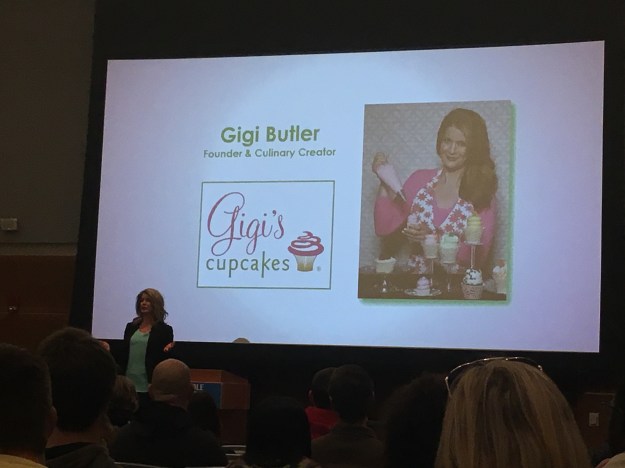
So when I learned she would be coming to the university where I teach, I made it a point of inviting myself to join the Business School students who were present during last year’s Entrepreneurship Week. I must say that I expected there would be more students in attendance. It still blows my mind that there are so many free opportunities for students to learn from people who are doing what they say they want to do; who they would never get a private meeting with, and yet so few, proportionately speaking, ever attend. I thought this was just an issue in my department. But that’s another story.

IMG_5253

As I sat in that auditorium listening to Gigi tell her story, I was taking mental notes, keying in on things that probably went right past others listening. I wasn’t interested in starting my own cupcake company, but I was interested in hearing about her entrepreneurial journey. And while I had read about much of it online and in various articles, I wanted to hear her tell the story of how as a teenager she started a small business to raise enough money to come to Nashville to pursue a music career. I wanted to hear from her how she built that first company into a success, made the move to Nashville, but struggled to make it in the music industry.

I listened intently about how she struggled financially, not making enough money playing the shows she was able to get (which is not that unusual for those seeking stardom in the music city), but still wanting to continue her pursuit of becoming an artist. And then she said it…

She talked about how she took on other jobs, and then decided to start up her former business again — a cleaning service. Gigi cleaned houses during the day, waited tables at night, and performed when she could.

Why did that interest me so much? Because I’m impressed with people who don’t allow their circumstances to consume them, but rather, will do what they can, what they need to do to keep moving forward. Gigi’s dream was to become a music artist. Her reality was that the years were passing by, and she had monthly bills to pay in order to survive.

She had to adjust her life to her new normal.

Too often we allow pride to get in the way of making the necessary adjustments in our lives when things aren’t going the we planned or things happen that we didn’t expect. Sometimes when our plans get altered, we get so bogged down in what we want to do, that we lose sight of what we need to do.

Of course, the rest of her story is obviously the bigger story that everyone focuses on. While coming to the realization that her original dreams were fading, she gave something else a try; something she had never anticipated being a part of her life, but it was the one thing that brought her the fame that perhaps she was seeking, and certainly more money than she could have imagined. Instead of building a singing career, she went on to build a cupcake empire.

If you’re curious for more information about Gigi Butler and Gigi’s Cupcakes, visit her website at: https://gigiscupcakesusa.com/about/gigis-story/

For now, I leave you with Gigi’s closing comments from that site, because they line up with words I would have shared with you as well.

“If I can convey just one idea to someone reading my story, it would be to believe in yourself, walk with integrity, work hard and trust in God. And maybe your life won’t turn out exactly how you were expecting or hoping it to be; but maybe, just maybe, it will be so much better than you could have ever imagined!

With God, all things are possible!

Blessings,

gigisignature

Preparing for a False Alarm

It was April, 2002. I had joined my family for a spring vacation at the beach. My mom and one of my sisters invested in a time share several years earlier, and I’d made the drive back to the South Carolina coast. It was the second or third night; several hours after we’d gone to bed, when we heard an alarm go off. Over the speakers in each room, which my father didn’t like, and insisted that they were listening devices, a recording of a man’s voice announced that there was an emergency in the complex, and that everyone needed to vacate their rooms.

We reluctantly left, but it was not easy. We didn’t smell smoke, and couldn’t figure out what kind of emergency would make the condominium staff force their residents out onto the parking lots in the middle of the night. The biggest concern for us was for my mom. Just months earlier she had begun using a walker to help get around, as she dealt with growing issues involving use and strength of her legs, a side effect, we were told, of the medicines she had been on for years following a kidney transplant.

As we exited outside the third floor hallway, we discovered that they had shut down the elevators. Our only escape was to descend down three flights of stairs, slowed down by those coming out from the second floor. But for my mom, it was even more of a challenge, trying to maneuver her walker down the hallway, not knowing the nature of the emergency and how much of a danger we may be in. And then having to go down one step at a time, worried all the while that people behind her might become impatient and possibly start pushing.

By the time we got to the bottom, the alarm stopped and the recorded message was telling us that the emergency was over; we could return to our rooms. It was now time to figure out how to get her back up three flights of stairs; as young and perfectly healthy people stood hovered around the elevators, not giving way to the elderly and the obvious disabled people who had no other choice. It was a night that set the tone for the rest of the week, as the pain in my mom’s legs grew more intense after the trauma of being forced to make her way downstairs and back up.

The next day, what my sisters and I suspected turned out to be correct; there was no real emergency. It was a false alarm! All of that physical and mental stress on my parents, for a false alarm! Yeah, I was really ticked off.

“BALLISTIC MISSILE THREAT INBOUND TO HAWAII. SEEK IMMEDIATE SHELTER. THIS IS NOT DRILL.”  — Cell phone message sent to residents and visitors in the Hawaiian islands at 8:07 a.m. January 13, 2018

This weekend we learned of the still head scratching news that a false alarm went out in Hawaii warning of a missile attack; and specifically warning that “This is not a drill.”

It took almost 40 minutes before the all-clear was given and people were told it was a false alarm. While some of the news stories this weekend focused on the panic this “false alarm” created, I was surprised by the reporting of how many people never got, saw, or heard the message, and continued on with their lives. And moreover, the number of people who received the message, but didn’t know what to do next.

How do you prepare for a missile attack? What do you do when you’re not at home — perhaps with access to your bomb shelter or basement, if you have one — when the alarm goes off?

What about your kids? Your spouse? Your elderly parents?

You see, it’s easy to practice a drill at home; tell your kids where to go if there’s a hurricane. Stop by the grocery store to prepare for a winter storm. Talk through where to meet up after a fire.

But what if you had only 20 minutes to seek protection from an incoming missile — from wherever you are when the alert goes out? What would be your plan? How would you communicate with your loved ones? How would you try to get back together? Or would you?

I don’t have the answers for any of these questions. But shouldn’t we be asking them?

There are many more questions being asked today than there were just a year, a month, or even a week ago. Because we saw first hand, in real time, through video and social media communication, how poorly prepared we truly are as the real threat from a neighboring country puts everything into perspective.

How prepared are you and your family for any type of emergency? Fire? Tornado? Hurricane? Terrorists?

What happens the next time when it’s not a false alarm?

Self-Care is Self Survival

For the most part, I hate undoing things. Or should I say dealing with the aftermath of having done something. Just like most people, I prefer putting up the Christmas tree and decorating the house for the holidays. But I dread the January time period of taking everything down and putting them away. I love planning and hosting parties, anytime a year, really, but loathe the clean up afterwards. And when it’s time to travel, whether I’m going 500 miles back home, or traveling 5,000 plus miles overseas, I am a terrible procrastinator when it comes to unpacking and putting things away after the trip.

If I could figure out a way to monetize a new business model, I would start a company where I would come plan your parties, pack your luggage, and decorate your house for whatever season, but only in return for people coming to my house to put all of my things away. Not sure how that would actually work, but that’s how much I hate doing it.

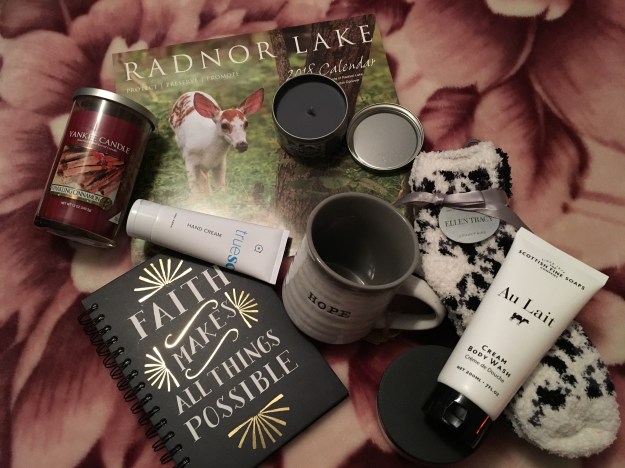
So I’m four days returning from my Christmas vacation, and my luggage still sits in the middle of the floor; an unopened one by the back door in the den, and the other one I’ve been picking through on an as-needed basis, in the bedroom. But I have made a little progress, in the form of sorting through my cards and gifts. Now I’m not saying I’ve made any progress with putting them away, or to use yet. But the fact that they’re out of their gift bags and on my bed — okay, stacked together next to my bed — is forward movement.

As I look at several of the little items gathered together, a theme seem to jump out at me. “Self-Care!”

Maybe I was looking for it without realizing it, but all of the thoughtful gifts were messages and reminders for me. And something that made starting 2018 more perfect.

Two of my friends bought me a bottle of doTERRA Frankincense essential oil that I’e already begun using. Now that may not seem like a big deal to you, but my friends didn’t just grab something off the shelf. They know me and knew about my health struggles I’ve dealt with over the years. And Frankincense is said to help relieve chronic stress and anxiety, and reduce pain and inflammation. I need help in all of those areas.

A week later a colleague gave me a placard for my office with the word “REJOICE” and the scripture Psalm 118:19-24 written on it. The phrase that stands out to me most, that I want to read each day I come to work, is the reminder to rejoice and be glad. Glad that I have a job to come to. Glad that I enjoy what I do (most days). Glad that I’m able to make a living at what I do. And glad that I’m making a difference in the lives of young people, even at times when I think I’m just talking in circles.

“…let us rejoice today and be glad.” Psalm 118:24b

IMG_5647

With the extreme drop in temperatures during the start of this year, I’ve been wearing the moisturizer and aloe-infused socks that one of my sisters gave me to bed each night since I got home. Today, I’m enjoying my second visit to Starbucks this week, compliments of a Starbucks gift card my other sister gave me. But I have to also admit, after popping four or five Truffles in my mouth in less than an hour, that sometimes denial is as important in the name of self-care! So I had to put the remaining box of that delicious treat in the freezer!

I appreciate all of my Christmas gifts from family and friends. There’s no one thing better than the next, because it’s always the thought; that someone even thought enough about me to want to share a gift this holiday season. But this year I’ve taken to heart those items that also point me in a direction I need to daily remember — to take care of myself.

There is a difference between self-care and self-obsession. While there are many people who spend way too much time and money on pampering and overindulging themselves, mostly at the exclusion to what may be going on with other people in the world around them, there are still many others who spend much of their time helping and giving to others; being there whenever someone calls; sacrificing their own needs for the needs of family, work or friends.

We have to remember to take care of ourselves if we are to survive. The overused airplane analogy is nonetheless a perfect picture of how we should approach life, in terms of how we give — emotionally, financially, physically, and relationally. And that is to remember to put on your own oxygen mask first before assisting others around you with theirs. No matter how tempting it is to reach for your children, or to assist your aging parent beside you, if you are not in a healthy state first, you will not be as effective to assist others. And quite possibly, you both may suffer as a result.

I’m looking forward to lighting one of my scented candles, slipping on a pair of those super soft socks, and enjoying a hot cup of tea in my large “HOPE” mug, while writing in my new journal. Yes, FAITH makes all things possible!

So as I kick off this new school year, and the pressures and workload of collegiate teaching in this environment grow, I’ll look to my gifts as subtle reminders of some of the things that should really be important.

REJOICE. HOPE. FAITH.

What great words to remember and to live by this new year!

Don’t Make Resolutions! Set Goals…

It’s that time of year…again! The time when we look back over the last 365 days of our life trying to figure out what we did and didn’t accomplish; are we better off or the same as we were this time last year; and what, if anything, we’re going to do differently in the new year.

I envision that on this particular weekend there are many people sitting at home, curled up in a chair, with their journal and pen, writing out their new year’s resolutions and promising themselves that they’re going to stick to them — this time.

I think one of the reasons we struggle with keeping our resolutions is because that’s what they are — a “resolve” to either start or stop doing something. But the problem is that we tend to stop there. We stop with our list of Dos and Don’ts, and pray for the willpower to accomplish everything before the end of another 12-month period. Losing weight. Eating healthy. Traveling more. Saving money. Maybe even dating or marriage?

What we lack with resolutions are goals and strategies.

If we resolve to eat healthier, then eating carrots instead of potato chips for an afternoon snack might technically achieve our resolve, but does it really meet the goal of becoming a healthier eater? Especially if we happen to binge on cookies later that evening?

What if instead we set as a goal to eat more vegetables, while also reducing our intake of unhealthy foods (such as those cookies, fast foods, red meats, etc.). But to reach our goals, we can’t stop there. We need to set strategies to help us accomplish them. Perhaps one of our strategies for that goal might be to eat 30 percent more vegetables each week. A second strategy for that same goal of healthy eating might be to eat 30 percent less junk food per week. Another strategy could be to purchase more fruits, vegetables, whole grains, and other healthy groceries, while buying fewer sugary snacks, empty carbs, or processed foods.

Now we’ve not only listed a goal to work on, but we’ve outlined some specifics steps to take to help reach that goal. Don’t resolve to drink more water in 2018. Instead, set a goal of drinking a certain number of ounces of water each day above what you’re already drinking. For me, my goal is to drink 64 ounces of water each day. Since I’m currently only drinking about half that amount, one of my strategies is to set a regular time period each day to drink at least eight ounces of water at preset intervals.

Of course doing these things sound a lot simpler than they turn out to be, because mostly they require work; hard work. But setting goals without outlining strategies to reach them is like dreaming about visiting France, but never setting aside time on the calendar, or saving up money, or making the travel plans to go. It won’t matter how much you desire it, if you don’t make the arrangements to achieve it, then you’ll never reach the goal of accomplishing it.

So plan that European vacation. Start that business idea. Write that book or short story. Join that pilates class. Learn that new language. But don’t make resolutions. Set Goals. And then create Strategies to achieve them, and a timeline to stay on track. Keep them realistic and attainable.

Then perhaps a year from now, you’ll be sitting thinking back over all of the things you accomplished in 2018, instead of regretting those “resolutions” that fell by the side just weeks or months into the new year.

You will be the same person in five years as you are today except for the people you meet and the books you read.”
Charlie “Tremendous” Jones


Free Shopping Days of Christmas

Don’t let the word “shopping” fool you! I’m not advocating going out and spending a lot of money this Christmas season. Quite the opposite. Because I’ve never quite understood why people will run up their credit cards to buy lots of things for many people who either don’t need what you’re buying for them, or would have loved a lesser priced gift from you. And for those with higher expectations, including family members, you have to ask yourself what do they value more — the monetary amount of a gift you can barely afford, or spending time together with an understanding that the holiday season isn’t a license to go further into debt, as so many Americans do!

I recently shared on the Catching Raindrops Facebook page that twice in the last three weeks Thorntons Gas has dropped a six cents off fuel rewards on my card. Both times it happened the day I needed to gas up! Just the other day, another one appeared. I may not need to gas up yet, but topping off my half tank before it expires tomorrow will still be beneficial! Last month I got a free cup of coffee from there as well. Then there was two weeks ago when I got a coupon from Kirkland’s for ten dollars! What great timing, because I need a new pair of gloves. I would never have thought to go there for clothing items, but just this morning, an email of sale items appeared? Not only were gloves listed on sale for FIVE DOLLARS, but so was a pair of women’s slippers, which I also need. So I’ll be getting two more things I need — for FREE! That’s MY kind of shopping.

Earlier this month I hit up Bath & Body Works and their $4.95 sale on aromatherapy products (these items are regularly $12.00-$15.00; and more), and was glad to be able to use my buy one get one free coupon which I’d been holding on to for the right moment. So YES, I got TWO aromatherapy products (i.e. Christmas gifts) that would have cost me over $25.00, instead for just $4.95!

And at Cost Plus World Market, after some “smart shopping” purchasing several bags of coffee for friends during their buy one get one free sale, I ended up earning another free BAG of coffee on my account for myself! But that wasn’t the end of my World Market venture. While there, I noticed an in-store treasure hunt, in search of the Golden Llama. I was too late for that day, but four days later, I decided to show up when the store opened. Yeah, there were about six other women with the same idea, but as the door opened, with the clue of the Llama being seen near something green, I decided to try my luck. While most of the ladies started near the front of the store, I headed straight to the back, looking at everything green. I found one! What started off as a silly game and marketing ploy, of course, won me TWENTY DOLLARS in shopping money! Okay, I admit I wish it had been one of the $50 or $100 rewards, but $20 was better than nothing! And apparently FREE money counts because later that day I had earned a TEN DOLLAR coupon to use later!


So why am I sharing all of this. Well, I’ve talked often about the benefits of joining Rewards programs before. Times like these are when I like sharing specific benefits to these programs. They’re free to join and you get rewarded for doing what you already do — shopping, getting gas, etc. I don’t join programs for places I don’t already visit. But getting rewarded — in other words, saving money — for engaging places I go to anyway makes perfect financial sense! It’s the very essence of catching raindrops in water buckets!

My Days of Christmas

On the first weekend of Christmas, I decided to give to me. A getaway to a cabin in the mountains — with two friends…and lots of cows, horses, and country views that went on for miles!

We planned this “start of the Christmas holidays” getaway almost 10 months ago after hearing about this cool place, Stone Farmhouse in Cookeville, TN. Who knew how much I would really need this weekend, get out of town trip. And what timing, as the school year was winding down, and me gearing up for another marathon of grading, final exams, and preparing for multiple Christmas outings and soon-to-be travels!

The cabin is on a 250-acre working farm. Inspite of that, it was relatively quiet, and we probably entertained the farm hands, with our early morning tire swinging in our PJs and fascination with the tiny pony and donkey, as they did us, watching as they dumped hay and feed for the animals, who I think were also amused at these city girls gone country!

The cabin was stocked with the essentials and included a queen size bed downstairs and a second bedroom with a queen bed upstairs, along with a loft area for cots or air mattresses. There was a large TV with a dish, so we didn’t miss any of our Hallmark Christmas movies, and a fireplace in the family room, even though we didn’t use it. Outside, there was a porch on both the front and back side of the house, a fire pit, and plenty of room to roam.

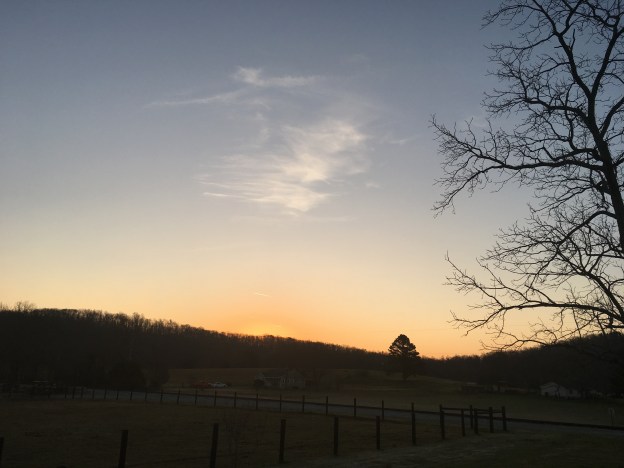
Of course we were there to kick off the holiday season, so in addition to sharing meals, watching Christmas DVDs, and exchanging Christmas ornaments, we also woke up early (well, two of us did!) for the beautiful sunrises, and ventured outdoors at night to track the full moon. We couldn’t have picked a better weekend, given the Super Moon surprise!

One of the best parts is that this cabin was reasonably priced; especially when split among friends. There is a push these days to give the gift of experiences over material presents; especially for adults. I would have to agree. That, and just time together is better than trying to figure out the perfect gift for someone. Candles will burn down; food will be eaten; wine will be drunk, and at some point you’ll probably stop wearing that new sweater, or playing with the latest video game. But experiences are unforgettable; especially when shared with friends (or even family)!

fullsizeoutput_12cb